



Sustainability has many meanings – but for Sächsische Ärzteversorgung, it is an integral part of our mission: to provide all our members with long-term, secure, fair and intergenerationally equitable care. Meeting needs over the long term, intergenerational equity and social participation define our understanding of sustainability.
We act in a sustainable and progressive manner and pursue a forward-looking sustainability strategy. We view ESG as an opportunity for value creation, whilst consistently avoiding sustainability risks. In this way, we fulfil our fiduciary responsibility and combine our long-term healthcare mandate with a key task for the future.
The members of the Administrative and Supervisory Committee worked with the administration to draw up objectives for a sustainable care mandate.
- Amendment to the investment policy: A key step in this direction was the amendment to the investment policy by the Supervisory Committee in April 2021. The criteria previously applicable to the investment strategy – security, profitability, liquidity, diversification and spread – were expanded to include the criterion of ‘sustainability’. This laid the groundwork for sharpening the understanding of sustainability risks and optimising the investment activities of the Sächsischen Ärzteversorgung.
- Drafting of a position paper: A position paper drafted jointly by the Administrative and Supervisory Committees was submitted for approval to the Extended Chamber Assembly, the pension fund’s highest governing body, in June 2021. By a clear majority, the elected representatives voted in favour of a sustainable orientation for the pension fund’s business operations.
- Development of the sustainability strategy: A critical yet constructive examination of the possibilities and limitations of sustainable operations at the Sächsischen Ärzteversorgung has resulted in the development of sustainability strategy (PDF).

From Strategy to Implementation
A strategy thrives on its consistent translation into operational measures. Numerous workflows have been reviewed, optimised and, in some cases, re-established. In doing so, both business processes and investment activities themselves have been further developed. The aim is to promote efficiency, sustainability and employee satisfaction in equal measure.
Through consistent digitalisation, we are making our processes paperless, efficient and future-proof. Strategic human resources planning encompasses not only a non-discriminatory working environment but also equal opportunities for career progression and professional development. Regular training opportunities for all employees are key to this. The pension fund creates incentives to use public transport by fully covering the cost of the so-called ‘Jobticket’. CO2 emissions caused by business travel are offset.
The measures the pension fund has put in place to strengthen its role as an active investor are far more complex. We have summarised our activities to date in our explanatory video on sustainability in investment.
Documentation, evaluation and ongoing development
Sustainability is a continuous, dynamic process. Processes are documented to ensure that progress and measures are transparent. Internal working instructions provide a basis for accountability to the pension fund’s governing bodies and also serve as a set of guidelines for day-to-day work relating to ESG. Regular evaluations enable an assessment of our own performance and encourage dialogue with experts and market participants.
An evaluation is particularly valuable when it is conducted independently. For this reason, the Saxon Medical Pension Fund has been a signatory to the UN Principles for Responsible Investment since 2021. This global investor and financial initiative ensures regular review of current standards and facilitates dialogue with experts and other market participants, including other pension funds.
In examining the sustainable orientation of Sächsische Ärzteversorgung’s business operations, many questions have been answered, but some remain unanswered. The financial sector does not have a conclusive concept for every problem, nor does the organisation have a (consistent) answer to every question.
Your contacts
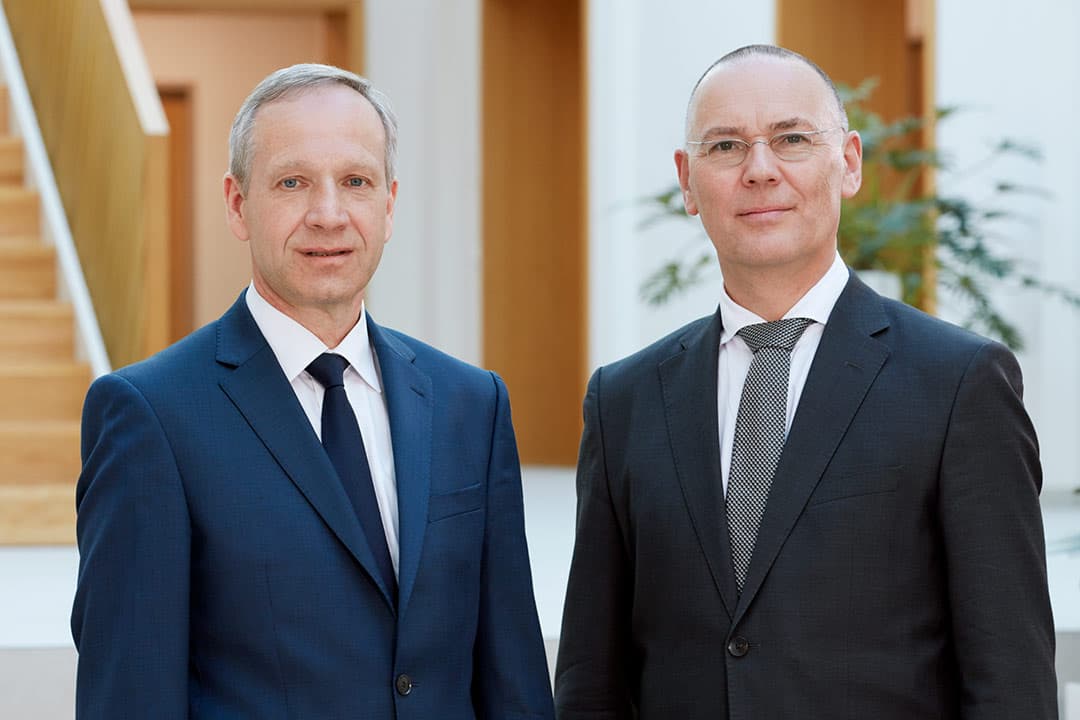
The Chair of the Supervisory Committee, Dr Volker Kohl (on the left in the photo), and the Chair of the Administrative Committee, Dr Steffen Liebscher (on the right in the photo), are responsible for ensuring that Sächsische Ärzteversorgung operates in a responsible and sustainable manner.
If you have any enquiries regarding sustainability, please feel free to contact us by email.
Frequently Asked Questions About Sustainability
In principle, Sächsische Ärzteversorgung does not focus on individual issues such as climate change and, in particular, CO2, but always takes a holistic view of E, S and G. Nevertheless, the need to reduce CO2 emissions is always factored into the assessment of opportunities and risks. To this end, we examine whether clear decarbonisation targets have been formulated (e.g. commitment to the Paris Climate Agreement) and whether strategies for reducing CO2 have been developed. Standardised procedures for calculating a carbon footprint are largely still at the development stage, and measurement methods exhibit systematic weaknesses, particularly regarding the attribution of CO2 consumption. Consequently, the pension fund does not use a carbon footprint as a management tool for its overall investment portfolio.
Particularly where it has its own scope for control – which is especially the case with SÄV’s own properties – Sächsische Ärzteversorgung responds by conducting a comprehensive data collection on resource consumption and, in a subsequent step, by adjusting this consumption to consistently save resources and thereby reduce its own carbon footprint in the long term. The Greenhouse Gas Protocol, with its Scope model, is applied in this process.
Exclusion criteria determine which investments are excluded from a portfolio. They serve to minimise risks to performance and usually relate to specific business sectors or practices.
For direct investments, for example, Sächsische Ärzteversorgung excludes manufacturers of controversial weapons, civilian firearms, tobacco companies and producers of pornographic content. In addition, companies are excluded if they demonstrably derive a high proportion of their turnover from controversial extraction methods such as oil sands or fracking.
Not all potentially risky sectors are excluded across the board. For instance, Sächsische Ärzteversorgung also invests in fossil fuel companies if they are actively transitioning to renewable energy. As an investor, the pension fund can support this transition through the exercise of voting rights and dialogue.
The definition of exclusion criteria is complex and not always clear from an ESG perspective. Therefore, sustainability aspects are carefully assessed for every new investment and incorporated into the investment process.
Sustainability is more than that. It is more than just measuring a CO2 footprint, more than non-discriminatory recruitment processes, and more than transparent administration. The term ‘ESG’ combines three perspectives on sustainability standards and has established itself globally as a framework for categorising sustainability measures. The ‘E’ stands for ‘Environment’ and covers all environmental issues, from greenhouse gas emissions to energy efficiency. “Social” (S), on the other hand, refers to social aspects such as the health and safety of the company’s own employees, demographic change or equality. All aspects of exemplary corporate governance with appropriate supervisory structures are subsumed under the term “Governance” (G). Issues such as corruption, risk and reputation management or compliance are examples of this.
The term ‘green investments’ is often understood to refer to investments with an environmental focus, such as renewable energy. For reasons of risk diversification, the Sächsische Ärzteversorgung does not focus on thematic investments. Indirectly, however, investments are made via bonds and shares in companies that can be classified within the renewable energy sector. In particular, in the area of infrastructure investments, the appointed managers have included such investments in their portfolios. These include, for example, investments in solar and wind farms, as well as companies specialising in hydrogen technology.